Sons of Liberty Draw Sons of Liberty Drawings Easy
Thanks to the History Channel, I was granted an early-access screening of the series Sons of Liberty (premiering 25 January at 9 p.m. ET). I binge-watched it for almost 5 hours and also reviewed tons of online content, press releases, and character biographies from the website. Previously, I had only seen and heard about the three-part miniseries through previews on television and social media. Despite some glaring inaccuracies spotted in the various trailers, it looked compelling. The production looked top notch and the acting seemed fun.
The previews give the feeling that it's a dramatization of real, historical events, with an air of credibility: credentialed historians pop up between frames of a smiling Ben Barnes (playing Samuel Adams) or a sarcastic Rafe Spall (playing John Hancock) as sparks fly everywhere from the firing of flintlocks. Understandably, one might get the impression from these sneak peeks that this is some sort of docu-drama. Well, it's not that at all.
You have to dig a bit to find it (it's never explicitly stated in the trailers or promotional content), but on History's website, they make it clear that this program is "is a dramatic interpretation of events that sparked a revolution. It is historical fiction, not a documentary." It goes on to state that one of the goals is to "focus on real events that have shaped our past." Whatever you do, don't take that statement too literally.

As historical fiction (actually, it's more of an alternate history) the miniseries is very successful. The acting is superb, some of the scenes are very clever, the special effects are fantastic (and believable), and—believe it or not—they actually included variations in the colors of the British soldiers' uniforms (not all of the red coats have buff lapels, cuff and collars; some have yellow and some blue)! This is actually a huge step up from previous dramatizations of British soldiers.
 While it plays well for those who are in on the secret, if you're looking for facts about the Sons of Liberty or information about the War for American Independence, don't plan on discovering those facts in this miniseries; you won't find them. Instead of portraying actual historical events and giving each character balance and depth, the writers and producers have gone with a standard archetype of good and evil—you can probably guess which side is good and which is evil. So instead of the real General Thomas Gage, the viewer is told (in promotional material) that Gage is a brutal dictator-type figure who is abusive to his wife and orders his soldiers to act just as ruthlessly to the point of igniting the fuse of revolution. It's complete bunk, of course, as we'll see below.
To help guide the serious students of history, here is a list of the first episode's most glaring historical inaccuracies and the real events and context behind them. There are too many to list them all, but this will get you started on the right path. Enjoy.
Episode 1:
It's Boston in 1765. Dr. Joseph Warren walks into a pub and stumbles into a drunk Samuel Adams. He explains to Adams that he's been looking for him just as a group of British Regulars storm into the pub; there is muttering about a warrant, issued by Governor Hutchinson, for Adams' arrest. The soldiers have come to collect! And we're already off to a bizarre start. There were no British regulars stationed in Boston in 1765. They were there 1768-1770 and 1774-1776.
- Doesn't Look a Day Over 30 – The producers went with a younger look for Samuel Adams in 1765; in real life, at that time, he was 43. Certainly not old, but not a young lad either. Don't get me wrong—Barnes is a fine actor and the producers wanted a hip fellow that all the kids can relate to and the girls swoon over—but Barnes is ten years younger than Adams would have been—was George Clooney not available (he asks facetiously)?
- That Pub-Crawler Sam Adams – Samuel Adams has an undeserved reputation as a drinker who hangs out in bars. This wasn't the case, at least not according to actual evidence. Samuel Adams inherited a brewery (which failed by 1764) and was called 'Samuel the Publican'. But as J.L. Bell points out, Samuel Adams' nickname has other connotations—it has nothing at all to do with pubs and alcohol.
- Samuel Adams the Well-to-Do – Adams is depicted as a poor man with a poor background (compared to his successful cousin John Adams). In the show, John Hancock talks to a man about Samuel Adams' father and how he lost everything to Governor Hutchinson. The elder Samuel Adams lost his investments in the Massachusetts Land Bank, which Hutchinson advocated against, while his namesake son was at Harvard. This was a standard interpretation from the 1920s thru the 1970s. In fact, the elder Adams suffered only a temporary setback and left his son substantial property. But the show's dramatic choice isn't out of left field.
- The Governator – Hutchinson was not the Governor of Massachusetts in 1765. He was Lieutenant Governor as well as a probate judge. He would not take over as Governor until 1769 (and then only as acting governor until he was fully commissioned in 1771). The enmity between Adams and Hutchinson is founded in real history, but not for the reasons given in the show.
- Civil vs. Military Authority – Under the English Bill of Rights (as well as the prevailing views of liberty at the time), British Civil Law was separate from Military Law (much as there is a distinction today), and military authority was viewed as being under the civil authority. Soldiers did not enforce the laws of the state and the state did not interfere in the judicial system of the military. All warrants were issued by sheriffs or magistrates and enforced by them alone.
- On Probation – No warrant was issued for Samuel Adams in 1765. In 1758—seven years before this scene supposedly takes place—the sheriff (not Hutchinson) put out a warrant involving the estate of Samuel Adams' father. The £8,000 was the total of uncollected taxes Adams owed to Boston as calculated in 1765. Instead of coming after him with a gun, however, the sheriff engaged him in public discussions (and threatened to take away his businesses, his home, and his property to repay the debt). Nothing ever came of the threats.
- The Tax Collector – Samuel Adams began his career as a Tax Collector in 1753, elected by general vote in a town meeting (not appointed by Hutchinson as the series suggests) thus making his term of employment much longer than the miniseries suggests (by 11 years, in fact). Adams did indeed fail to collect fines, and probably for some of the reasons mentioned in the show (he wanted to be liked and was probably also looking out for friends). He wasn't removed from his position as tax collector so much as he was promoted from that job to one of Boston's four seats to the provincial legislature.
- Destruction of Property – Hutchinson's Mansion was indeed sacked, but not for the reasons given in the show (absolutely not because of Samuel Adams' warrant and his debt) and not on that date (it was actually sacked about two weeks later). It was actually over the Stamp Act, as Bob Ruppert explains. Hutchinson's house and possessions were all nearly destroyed and, unlike the show, Hutchinson didn't immediately return to his North End mansion, but eventually it was rebuilt. The mob also looted his expensive belongings—most of which were never returned or recovered (it wasn't just the destruction of a painting).
- Assassin's Creed – Yeah, at one point Samuel Adams is climbing up walls and running across the roofs of Boston like in the popular video game. That didn't happen, folks. Let's be honest though; it sure looked cool.
- Where in the World is Thomas Gage? – Historically, Gage had already been given command of British forces in North America in 1763. He had been in the colonies and in Canada since 1755, ten years prior to the Stamp Act riots; so I was surprised that the episode introduces him hanging out in England in 1765, completely unaware of events unfolding in Boston. In 1765, Gen. Thomas Gage was living in New York. He visited Boston in 1768 but was not closely involved in that town's politics until he arrived as governor in 1774. Since Gage's relationship with Adams is part of the premise of the series, it was a little off-putting to see such a glaring historical inaccuracy. We'll come back to this.
- The Not-So-Eligible Bachelor – Samuel Adams remarried in 1764, unlike the bachelor-esque depiction of him in the show. He was not homeless either. Soon after Samuel Adams was elected to the Massachusetts legislature, that body chose him as its Clerk. That gave him a salary which, with frugal living and friends' support, allowed him to live a simple genteel lifestyle for the next several years. He had put his failures in business behind him at that point. His outstanding debt was really those uncollected taxes. And yes, John Adams never hosted his cousin.
- Benjamin Franklin in London – Yes, Franklin was in London in 1765, but not—as the show claims—because he was kicked out of the colonies by the whigs/populists. In fact, Franklin was there to petition the king to make Pennsylvania a royal colony. He probably did have his way with women, but he also took time while there to protest the Stamp Act.
- An Angry and Vengeful Parliament – The whole scene where parliamentary officials give license for British troops to enter homes and destroy personal property and seize possessions is nonsense. In fact, parliament was pretty out of touch with American sentiment in the colonies to the point of fault. While they instituted the Coercive Acts, they ignored General Gage's requests time after time to send more troops and munitions because he was worried about a war breaking out.
- What British Soldiers Didn't Do in Boston – Let's just cover these now (thanks to J.L. Bell for parts of the list) because the show just depicts the British army in all the wrong and mythological ways it can.
- Soldiers didn't arrest patriot/populist leaders. No homes were stormed, family members seized, or fathers taken away from crying sons.
- Soldiers didn't shut down any patriot newspapers. The two of the most radical papers continued to publish until the printers left town just before the war broke out in April 1775.
- Soldiers did not try to stop the Powder Alarm of 2 September 1774, the Worcester court uprising, any of the Massachusetts's conventions, or meetings of the illegal Massachusetts Provincial Congress.
- Soldiers did not retaliate against the 400 armed New England militiamen who stormed Fort William and Mary, assaulted five soldiers and an officer (who fired on the militia after demanding they stop several times), and stole all the gunpowder stores, weapons, and ammunition, in December 1774.
- Soldiers were not quartered in unwilling civilians' homes, despite the popular myth to the contrary. In 1774 and early 1775, the only British military men staying in civilian homes were officers renting rooms from willing hosts. Back in 1768 and after the war started, the British army did use some public buildings.
- In 1774 the army didn't use or confiscate public buildings as barracks. The troops were housed in tents on Boston Common. Eventually barracks were constructed from old warehouses and other unused buildings, all rented from their actual owners.
- Soldiers did not use force to break up peaceful political demonstrations.
- Soldiers did not issue or enforce warrants. Despite the show's insistence that British Regulars entered homes and gave summonses to attend court hearings for missed payments, none of this happened.
- Soldiers didn't broadly shut down businesses owned and run by patriots. The troops came to Boston to help the Customs service enforce the Boston Port Bill, so in a sense they did shut down businesses that involved trade through the harbor.
Episode 2:
December 1773. Men with painted faces and in loose clothes. A shot of Boston Harbor. You can probably guess where this is going.
- Leaving Tea in the Harbor – There is just too much to cover here. I'll leave it to Benjamin L. Carp to fill the reader in on the facts concerning the dumping of the tea.
- The Commander in Chief – General Gage finally shows up! Ten years later in the show than he did in the historical timeline. Gage took charge of military affairs in America in 1763, not 1773. In actuality, Gage went back to England for a year (incidentally in 1773) and returned to the colony in 1774, when he relieved Hutchinson of his Governorship in Boston.
- Missing Action – During the time this is all happening, a lot of intense history is missing. The Worcester Rebellion in 1774, the establishment of the Provincial Congress and Committee of Correspondence (of which some of the main characters were a part), the Powder Alarm, etc. These were key early successes of the Sons of Liberty that aren't discussed in any of the episodes. All of this missing action is probably why Hancock's assessment, after seeing the slim pickings of the First Continental Congress in Philadelphia, that it didn't have the making of a resistance seems a little ignorant.
- Frenemies – The comment from Washington about Gage being "a cancer" is preposterous. They were friends throughout the Seven Years War and Washington even attended a farewell dinner in Gage's honor before Gage left for England in 1773. They ended their friendship when war began, but in 1774 Washington would have spoken highly of Gage.
- What General Gage Didn't Do During the Boston Occupation – See earlier list about British Regulars.
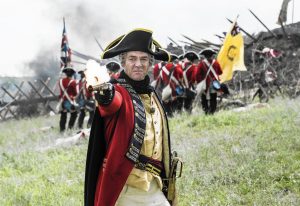
This is a good time to talk a little about the character and position of General Gage. He is severely misrepresented in the series. It's a little sickening. Like in the movie The Patriot, the British soldiers come across as fascists. The producers undoubtedly want viewers to feel sympathetic to the Bostonians, but they do so at the expense of the British soldiers' humanity. They might as well be Stormtroopers from Star Wars (in fact all the scenes of them marching through the streets of Boston remind me of the Stormtroopers roaming around the narrow corridors of the Death Star).
Gage, for all his idealism, really cared about the colonies; he married a woman from New Jersey, his children were raised in America, and he owned lots of land in America. He held 'whiggish' political views and had a firm love of law to the point of possible fault (so his officers thought). Unfortunately the series just throws out all the real evidence about his character. It glosses over the most important historical aspect of his legacy: he never tried illegal means to stop Samuel Adams. He tried very hard to do that within the law.
Indeed, he allowed Paul Revere to consistently disrupt his troops. This drove his subordinates to frustration. Lord Percy wrote of his commanding General, "The general's great lenity and moderation serve only to make them [the patriots] more daring and insolent."
Gage respected where he stood within the realm of government, according to the English Bill of Rights. In the show, Gage orders his soldiers to flog a civilian for stealing goods from a British naval ship. He could not have ordered this action. As stated before, there was a separation between civilian and military law and justice. Gage had no authority to punish a civilian for theft. He could, and did, punish his own soldiers for theft and other crimes—including crimes committed against the colonists. The scene in the series of the man being flogged is a fantasy. Another point: The Royal Navy had its own system of discipline separate from the army.

As is the scene of Gage taking over Hancock's home. Again, this is a misunderstanding of the Quartering Act. Before the war, Gage would have to ask permission to live in Hancock's home as a guest and pay rent to him if given approval. A British general took over Hancock's home in mid-1775 after the war had started and Hancock had been gone for months. Likewise, the American army was taking over vacant Loyalists' homes outside of Boston.
style="display:inline-block;width:336px;height:280px"
data-ad-client="ca-pub-6562459458985818″
data-ad-slot="3189640684″>
These men trained openly, not in the woods as shown in the episode. It was actually the law in Massachusetts to drill every few months. Gage knew this and didn't make any attempt to stop this from happening. And he did not disarm the population; that is an oft-repeated myth that the series picks up and uses without any critical thought. Gage did not touch privately-owned guns and munitions because seizing private property would violate the law—the very thing Gage held dear.
Lord Percy, one of Gages' subordinates, and other officers were quite upset about this. Percy noted, "The Gen'l has not yet molested them in the least. They have even free access to and from this town, tho' armed with firelocks [muskets], provided they only come in small nos [numbers]."
Meanwhile, Gage disarmed his own soldiers in Boston; he gave orders to Regulars to cease walking around town with their side arms and to never have loaded weapons when on guard. In one instance, a soldier wounded a civilian with a sword who had insulted him and started a riot that caused a brawl. The soldier was court martialed.
These orders seem strange in the context of the narrative presented in the series, but for the historical General Gage these were decisions of consequence. He wanted reconciliation. He wanted peace. And that is why Revere and the others were permitted to go about their business without much harassment. Gage admitted that he had done all he could to be mediator for peace in his letter to Congress in October of 1774.
Even when he ordered the march to Concord in April 1775, his target wasn't private citizens' arms but the Provincial Congress's collection of munitions and cannon. By securing artillery-through purchases, legislative actions, theft, and in one case an armed mob-New England's leaders gave clear indications t hat they were preparing for war.
Nevertheless, Gage explicitly gave orders to Lt. Col. Smith and Major Pitcairn before they departed towards Concord to avoid taking any private property, including arms; "you will seize and distroy all Artillery, Ammunition, Provisions, Tents, Small Arms, and all Military Stores whatever. But you will take care that the Soldiers do not plunder the Inhabitants, or hurt private property."
Only after the war broke out, in June 1775, did Gage arrest any patriots within the walls of Boston. At that point, however, most had left the city.
- The Gunpowder Plot – While it never happened (powder was too precious), the explosion of the powder magazine was pretty cool. There was a tussle over the province's gunpowder supply stored in modern Somerville on 1 September 1774, but no explosion.
- The Informant – Did Mrs. Gage inform Dr. Joseph Warren of the impending attack on Concord? Meh, doubtful. See this article by Derek Beck.
- The Famous Ride – I won't rehash what others have written.
- Did Paul Revere's Ride Really Matter?
- Dissecting The Timeline Of Paul Revere's Ride
- Paul Revere's Other Rides
- Paul Revere's Other Riders
- Shot Heard Round the World – Nothing about the depiction of the skirmish at Lexington is remotely accurate. Those interested in learning more can read the depositions and accounts of participants; see Derek Beck's excellent examination of who shot first (and the comments as well, which are informative).
- Brutality – The scene where Major Pitcairn orders a wounded colonist killed is fiction. The only helpless wounded man deliberately killed by an enemy was a British soldier.
Episode 3:
I won't go into the last episode which is just more of the same (though if any readers, after watching the program, wish to add their own list, please do so in the comments below).
Conclusion:
I can see why the History Channel added a disclaimer on their site. This is not meant to be a literal account of the onset of the American Revolution. It certainly isn't even a history of Boston's Sons of Liberty.
With this quick guide, readers and viewers of the show will hopefully have a better grasp of the content, the way it has been altered, and where to look to find the correct information (for example, be sure to use the search function at the top of this page).
The takeaway from this is that the Sons of Liberty program is highly entertaining historical fiction. We hope it energizes more people to study the Revolution and discover the truth behind these events. In many cases, the real story is better than fiction.
Source: https://allthingsliberty.com/2015/01/discover-the-truth-behind-history-channels-sons-of-liberty-series/

Post a Comment for "Sons of Liberty Draw Sons of Liberty Drawings Easy"